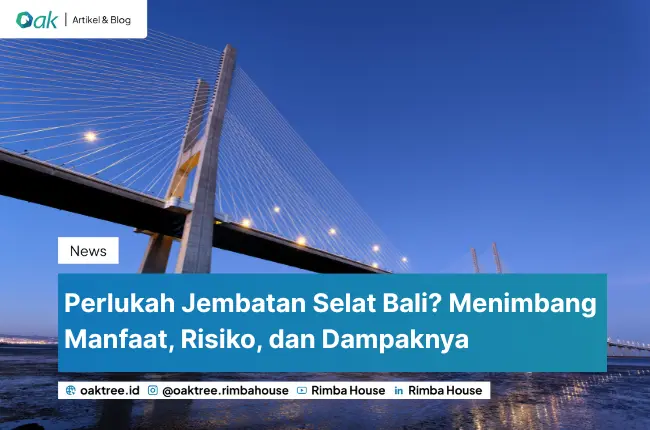
The Bali Strait Bridge is often framed as a strategic project capable of delivering broad economic benefits, not only for Bali and East Java, but also for the national economy. Its expected economic benefits are structural and long-term, particularly through improved connectivity, greater logistics efficiency, and market integration across regions.
1. Lower Logistics Costs and Travel Times
A permanent land connection could reduce reliance on a sea-crossing system governed by ship schedules and capacity. Reduced wait times, vehicle operating costs, and the risk of weather-related disruptions could lower the cost of distributing goods. In the broader economy, logistics efficiency is a key factor in boosting productivity and reducing production costs across sectors.
2. Strengthening Economic Integration Between Java, Bali, and the Eastern Region
Java serves as a national production and distribution hub, while Bali is a center for tourism and consumption. A bridge could strengthen market integration between the two regions, facilitate the flow of goods, workers, and services, and support connectivity to eastern Indonesia. This integration could generate economies of scale and expand market reach for businesses.
3. Impact on Regional GDP Growth
Various infrastructure studies show that improved land connectivity can gradually contribute to additional regional economic growth. For large-scale connector projects, the impact is generally not immediate, but emerges over the medium to long term through increased economic activity, trade, and investment. In an optimistic scenario, the contribution to regional economic growth could be in the range of 0.2%–0.3% per year, provided it is supported by spatial planning policies and the development of productive sectors.
4. Boosting Investment Appeal and Business Activity
Reliable connecting infrastructure is often a decisive factor in investment decisions. The Bali Strait Bridge could spur the development of logistics zones, warehousing, processing industries, and supporting services in the surrounding areas. These activities could generate a multiplier effect on regional income and employment.
5. The Risk of Inequality If Not Properly Managed
Although it could boost overall economic growth, these benefits would not automatically be distributed evenly. Without sound regulation and planning, economic growth could become concentrated in certain areas, put pressure on local businesses, and increase strain on resources and the environment. For this reason, macroeconomic benefits must be considered alongside policies to manage social and ecological impacts.
[irp posts=”3157″ ]
Impact on Bali Tourism
Tourism is the backbone of Bali’s economy, so any large-scale infrastructure project—including the proposed Bali Strait Bridge—would have significant implications for the sector. Its impact would not be limited to improved accessibility, but would also affect destination quality, tourist travel patterns, and the long-term sustainability of tourism in Bali.
1. Improving Accessibility and Visitor Flows
A bridge could make it easier for domestic tourists traveling by land from Java to get around. Faster access without ferry queues could encourage an increase in visitor numbers, particularly mass-market tourists and short-trip travelers.
2. Changes in Tourism Patterns
Easier land access could shift Bali’s tourism model from an exclusive, experience-based destination to one that is more accessible and sees heavier visitor traffic. This change could increase tourist numbers, but also put pressure on destination capacity.
3. The Risk of Over-Tourism and Infrastructure Strain
A surge in tourist traffic without proper controls could worsen congestion, waste, water availability, and environmental degradation. Without adaptive tourism management, short-term economic benefits could come at a high cost in environmental damage and declining quality of life for local communities.
4. Impacts on Bali’s Image and Cultural Values
Bali has long been positioned as a destination with a distinctive culture and a balance between nature, tradition, and tourism. A permanent land connection is feared to change how Bali is perceived and its image, from an island with a natural boundary into an area that is increasingly physically integrated with Java.
5. Opportunities for Regional Tourism Development
On the other hand, a bridge could also create opportunities to spread tourism more evenly to West Bali and the areas around the Bali Strait, which have so far been relatively underdeveloped. With proper planning, the project could support sustainable tourism and ease pressure on major destinations such as South Bali.
[irp posts=”3077″ ]
Environmental and Ecological Risks in the Bali Strait
The Bali Strait is more than a geographic divide between the islands of Java and Bali—it is a dynamic marine ecosystem of high ecological value. As a result, large-scale infrastructure projects such as a bridge could have complex environmental impacts, both during construction and over the long term once operational.
1. Disruption to Marine Ecosystems
Construction activities such as pile driving, seabed dredging, and heavy equipment traffic could disrupt marine habitats. Changes in water quality, turbidity, and noise levels could affect plankton, fish, and other marine organisms that play an important role in the Bali Strait ecosystem.
2. Changes in Currents and Sedimentation
The Bali Strait has strong ocean currents and plays a role in the exchange of water masses between the Java Sea and the Indian Ocean. A bridge structure could alter current and sedimentation patterns, potentially causing coastal erosion in some areas and siltation in others.
3. Risks to Conservation Areas and Fisheries
Changes in marine conditions could directly affect fishing grounds and conservation areas around the Bali Strait. Lower catches, disrupted fish migration routes, and damage to coastal habitats could impact the economic sustainability of coastal communities.
4. Vulnerability to Natural Disasters
The Bali Strait is in an area with considerable seismic and volcanic activity. The risks of earthquakes, tsunamis, and extreme ocean currents are important factors to consider when assessing the project’s environmental safety and long-term sustainability.
5. Challenges of Long-Term Environmental Management
Environmental impacts don’t end when construction is complete. Bridge operations would increase human activity and vehicle traffic, placing greater pressure on surrounding areas. Without strict environmental monitoring and regulations, the risk of ecosystem degradation could gradually increase.
[irp posts=”3131″ ]
Technical and Geographic Challenges
In addition to economic and environmental considerations, plans to build the Bali Strait Bridge depend heavily on technical feasibility and the geographic conditions along its route. The Bali Strait has a complex natural environment, calling for advanced engineering and careful risk mitigation.
1. Geological Conditions and Seismic Zones
The Bali Strait is in an area affected by tectonic and volcanic activity, including its proximity to a subduction zone and volcanic activity in Java and Bali. This raises the risk of earthquakes, so the bridge must be designed to withstand high seismic loads over the long term.
2. Ocean Currents and Water Depth
The Bali Strait is known for its strong, dynamic ocean currents, particularly due to the meeting of water masses from the Java Sea and the Indian Ocean. Variations in currents and water depth pose significant challenges to bridge foundation construction, both in terms of safety and structural stability.
3. Construction and Technological Complexity
Building a long-span sea bridge requires advanced construction technology, specialized materials, and high safety standards. This directly affects costs, construction timelines, and technical risks during construction.
4. Resilience to Extreme Weather and Corrosion
Marine environments accelerate corrosion of construction materials. Strong winds, high waves, and extreme weather changes must also be factored into the design to keep the bridge safe and functional throughout its service life.
[irp posts=”3071″ ]
Alternatives to the Bridge
Before deciding to build the Bali Strait Bridge, it’s important to assess policy alternatives that could deliver similar benefits with more manageable risks and costs. These alternatives focus on optimizing existing transport systems without permanently changing the geographic structure and ecology of the Bali Strait.
1. Modernization of Ketapang–Gilimanuk Ports
Expanding dock capacity, upgrading cargo handling facilities, and managing vehicle routes can reduce queues and wait times. Port modernization can be completed relatively quickly compared with bridge construction.
2. Expanding and Modernizing the Ferry Fleet
Adding larger vessels with higher safety standards can increase passenger and cargo capacity while easing congestion during peak periods.
3. Digitizing Queuing and Logistics Systems
Online reservation systems, data-driven vessel scheduling, and integration with land-based logistics systems can improve efficiency without major physical investment.
[irp posts=”3062″ ]
Optimize Logistics and Distribution Management in an Era of High Connectivity
Major infrastructure projects such as the Bali Strait Bridge create opportunities for economic growth and more efficient logistics flows. But without the right digital systems, increased cargo volumes and more complex processes could become a major challenge for logistics and freight forwarding companies.
📦 Now is the time to make the most of Oaktree, freight forwarding & logistic management software designed to help your business manage operations seamlessly, from job orders and shipment tracking to real-time reports, accounting, and multi-branch control—all in one cloud-based system.
With Oaktree, your business can:
📌 Manage increased cargo volumes more efficiently
📊 Track shipment status in real time
⚙️ Automate document creation and cost reporting
📈 Get full visibility into your logistics operations
👉 Ready for a new era of connectivity after the Bali Strait Bridge?
Start digitizing your logistics and accelerate your business growth with Oaktree to manage every freight forwarding process faster, more accurately, and more efficiently.
[irp posts=”1865″ ]
Conclusion
Plans to build the Bali Strait Bridge reflect a classic dilemma in strategic infrastructure development: the need for connectivity and economic efficiency versus environmental, social, and cultural risks, as well as significant technical challenges. On one hand, the bridge could streamline logistics, strengthen economic integration between Java and Bali, and drive long-term regional growth. On the other, the project would have major, permanent consequences, particularly for the Bali Strait ecosystem and Bali’s social and cultural character.
The discussion shows that connectivity between Java and Bali is not limited solely by the lack of a bridge, but also by the capacity, management, and efficiency constraints of the existing transport system. A bridge is therefore not the only policy option. Alternatives such as optimizing ports, reforming ferry operations, and digitizing logistics could deliver significant benefits with more manageable and flexible risks.
Ultimately, the decision on the Bali Strait Bridge should not be driven solely by development ambitions, but by data-based analysis, comprehensive cost-benefit calculations, and consideration of sustainability across generations. Strategic infrastructure is not just about building the biggest or fastest option, but about choosing the solution that is best for the economy, the environment, and society in the long term.



 Oaktree.id11 min read