Why Is the Panama Canal So Important to the Global Economy and Logistics?
 Oaktree.id7 min read
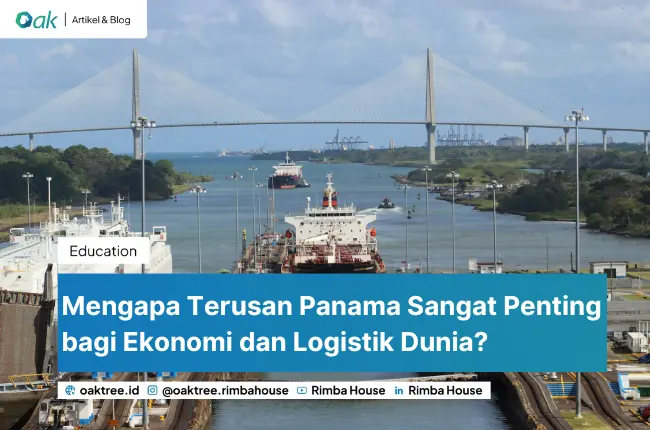
The Panama Canal is one of the world’s most strategic shipping routes, connecting the Atlantic and Pacific Oceans. Since opening in 1914, it has been a vital artery for global trade, allowing ships to save thousands of kilometers of travel compared with going around the southern tip of the Americas. In today’s economy, where efficiency and speed are essential, the Panama Canal plays an increasingly vital role, especially for the logistics, manufacturing, and consumer goods distribution industries. This article explores why the canal is so important, how it affects global supply chains, and the challenges that could threaten its continued operation in the future.
[irp posts=”3051″ ]
What Is the Panama Canal?
The Panama Canal is an approximately 82-kilometer-long artificial waterway that connects the Atlantic Ocean (via the Caribbean Sea) with the Pacific Ocean. Located in Panama, it allows ships to travel between the two oceans without taking the much longer route around Cape Horn at the southern tip of South America.
The canal consists of a series of artificial lakes, cut channels, and locks that raise and lower ships to a height of about 26 meters above sea level. This system allows ships of various sizes to pass through a route that was previously impassable.
In practical terms, the Panama Canal shortens sailing times, lowers logistics costs, and supports the smooth flow of international trade. As a result, it is one of the world’s most important and strategically significant maritime infrastructure projects.
[irp posts=”3035″ ]
History of the Panama Canal
The history of the Panama Canal is a long journey marked by ambition, failure, conflict, and ultimately success—one that transformed global trade. The idea of creating a shortcut across the Isthmus of Panama first emerged in the 16th century, when Spanish explorers recognized the strategic importance of the region in connecting two oceans.
The first construction effort began in 1881 under French engineer Ferdinand de Lesseps, who had previously built the Suez Canal. But the project failed completely due to formidable technical challenges, poor management, and outbreaks of malaria and yellow fever that killed tens of thousands of workers. The effort was abandoned in 1889.
The United States took over the project in the early 1900s after supporting Panama’s independence from Colombia. With a more practical engineering approach and a large-scale public health program to control tropical diseases, construction resumed in 1904. After the monumental work of excavating land, building a lock system, and creating Gatun Lake, the Panama Canal officially opened on August 15, 1914.
The canal remained under U.S. control until 1999, when full administration was transferred to the Panamanian government under the Torrijos–Carter Treaties. Today, the Panama Canal is an important symbol of engineering innovation and one of the most vital trade routes in the global economy.
[irp posts=”2981″ ]
Why Is the Panama Canal So Important to Global Logistics and the Economy?
The Panama Canal plays a key role in global logistics and the economy because it directly affects the efficiency, cost, and speed of international trade. It shortens shipping routes between the Atlantic and Pacific by thousands of kilometers, sparing ships the much longer, more expensive, and riskier journey around Cape Horn in Chile. As a result, shipping times can be significantly reduced, ultimately lowering logistics costs for companies across various sectors.
For global supply chains, the Panama Canal is a vital route connecting production hubs, especially those in Asia with North America, and vice versa. Many essential commodities—including energy, industrial raw materials, and containers filled with everyday consumer goods—depend on the smooth flow of ships through the canal. Even a minor disruption can have a domino effect, causing shipping delays, higher freight costs, and supply shortages.
The Panama Canal also makes a significant contribution to the global economy by supporting price stability and keeping international trade moving smoothly. The efficiencies it creates help companies stay competitive, while countries that rely on imports and exports benefit considerably. That’s why the Panama Canal is more than just transportation infrastructure—it is also a vital pillar supporting the dynamics of the world economy.
[irp posts=”2812″ ]
Risks and Challenges Facing the Panama Canal
The Panama Canal plays a vital role in global trade, but this strategic route also faces various risks that could disrupt its smooth operation. Understanding these risks and challenges is essential to seeing just how much global logistics stability depends on the canal.
1. Climate Change and Prolonged Drought
Climate change is the greatest threat to Panama Canal operations. The canal relies heavily on Gatun Lake as its water source for operating the locks. Extreme weather, particularly El Niño, has caused a significant drop in rainfall. When the lake’s water level falls, the canal’s capacity to accommodate ships also decreases. This forces canal authorities to limit the number of ships allowed to pass each day, ultimately creating long queues, shipping delays, and higher transit costs. The effects are felt not only in Panama, but also by industries around the world that depend on this route.
2. Capacity Constraints Amid Growing Trade Volumes
Although a major expansion was completed in 2016 to accommodate Neopanamax vessels, global demand continues to grow alongside the expansion of manufacturing, e-commerce, and international trade. Many modern ships are getting larger, meaning not all of them can pass through the canal—or they can do so only with certain restrictions. As a result, trade growth cannot always be matched by the canal’s capacity. When demand exceeds capacity, bottlenecks, longer wait times, and higher transit fees can follow. These conditions can potentially disrupt global supply chains.
3. Geopolitical Risks and Global Instability
As a strategic trade route, the Panama Canal is highly affected by global geopolitical dynamics. Trade disputes between major powers such as the United States and China, economic sanctions, and shifts in diplomatic relations can all affect the volume of ships passing through. The canal also holds significant strategic value, making it vulnerable to sabotage or security threats. Such instability not only increases risks to canal operations but can also create uncertainty in the flow of international trade.
4. Technological Challenges and the Need for Modernization
Operating a canal that serves as a vital global trade route requires constantly updated technology. The lock system, water control infrastructure, and navigation facilities must all operate with a high degree of precision. As the canal ages—it has been in operation for more than a century—maintenance and modernization efforts are becoming increasingly complex and costly. Without ongoing investment, the risk of damage, ship accidents, or operational disruptions may rise, affecting the stability of global logistics.
5. Economic Pressure and Global Dependence
The Panama Canal is an important part of the global economy. The world’s reliance on the canal is so great that even a minor disruption can have a domino effect on product prices, shipping costs, and supplies of essential commodities such as energy and agricultural products. Countries that depend heavily on imports or exports by sea may face higher inflation or lower productivity if the canal is not operating optimally. This shows just how sensitive the global economy is to the canal’s operating conditions.
[irp posts=”2978″ ]
Tackle Logistics Challenges with Smarter Systems
Disruptions to a strategic route like the Panama Canal can slow shipments, drive up costs, and create uncertainty in supply chains. That’s why logistics businesses need systems that provide end-to-end visibility, fast coordination, and seamless document management.
With Oaktree, you can track shipments in real time, manage digital documents more efficiently, and ensure every process runs smoothly, even amid global changes.
Strengthen your logistics operations today with Oaktree and make your business better prepared to face global challenges.
[irp posts=”1869″ ]
Conclusion
The Panama Canal is one of the world’s most important trade routes, helping speed up logistics flows and lower global shipping costs. Its long history shows just how strategically important it is in supporting international economic growth. However, risks such as climate change, capacity constraints, technical challenges, and geopolitical dynamics make it infrastructure that must be carefully protected. Any disruption to the canal can have a major impact on global supply chains, showing just how sensitive the global economy is to the stability of trade routes.
In this context, logistics businesses need to strengthen their operational systems to stay adaptable and efficient, even in the face of global uncertainty. Modern tools like Oaktree are becoming increasingly relevant for ensuring smooth shipments and full visibility amid today’s logistics challenges.