China Attacks Taiwan: What It Means for Global Trade, Technology, and Supply Chains
 Oaktree.id10 minute read
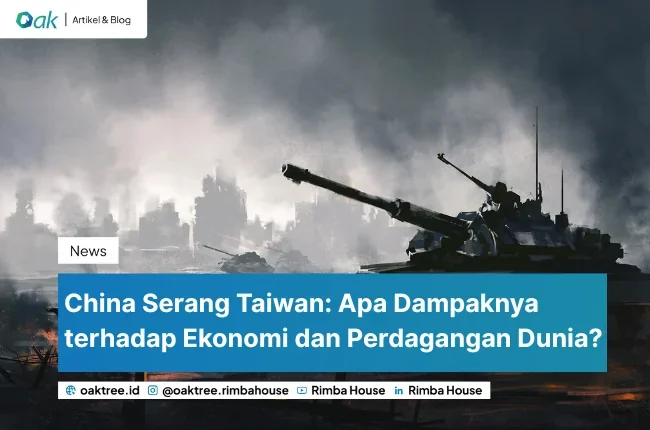
Tensions between China and Taiwan, which could lead to a scenario in which China attacks Taiwan, have long been a sensitive geopolitical issue in the Asia-Pacific region. But the prospect of an attack or military escalation is no longer just a diplomatic concern—it’s a real threat that could shake the global economy. Taiwan is not only strategically important from a military perspective, but also a hub for the global semiconductor industry, producing a large share of the advanced chips used in smartphones, electric vehicles, computers, and modern defense systems.
If China were to launch an attack, the impact would be felt far beyond the two countries involved. The world could face major disruptions to global supply chains, soaring energy and commodity prices, financial market volatility, and a reshaping of international trade. In other words, this would be more than a regional issue: it could become a new turning point for the global economy, following the pandemic and the Russia–Ukraine war.
In this article, we’ll take an in-depth look at how an escalation between China and Taiwan could affect global trade, global supply chains, and the future of technology.
[irp posts=”3086″ ]
Background to the China-Taiwan Conflict
The conflict between China and Taiwan is rooted in a long history dating back to the end of the Chinese Civil War in 1949. After the Chinese Communist Party took control of the mainland, the Republic of China (ROC) government retreated to the island of Taiwan and maintained its state institutions there. Since then, China has viewed Taiwan as part of its territory and committed to reunifying it with the mainland, through diplomacy or, if necessary, military force. Meanwhile, Taiwan has developed into a modern democracy with a political and economic identity increasingly distinct from mainland China.
Tensions have risen over the past several decades due to a range of factors, including growing support for Taiwan from the United States and Western countries, the development of Taiwan’s semiconductor industry—which is critical to global technology—and China’s military activity around the island. Visits to Taipei by senior Western officials, Chinese military exercises in the Taiwan Strait, and Beijing’s “One China Policy” have further heightened geopolitical tensions.
For China, Taiwan is important not only for historical and ideological reasons, but also for its military, economic, and technological value. For Taiwan, maintaining the status quo provides room to protect its democracy, national identity, and dynamic economy. These opposing goals make the situation increasingly fragile and vulnerable to escalation.
Against this backdrop, the threat of a Chinese military attack on Taiwan is more than a regional conflict—it’s a major geopolitical development that could alter the global balance of power. If tensions escalate into military action, the consequences would reach far beyond the Asia-Pacific, posing a new challenge to global economic stability.
[irp posts=”3093″ ]
Taiwan’s Importance in the Global Technology Ecosystem
Taiwan plays a crucial role in the global technology ecosystem, particularly as a world-class semiconductor manufacturing hub. Companies such as Taiwan Semiconductor Manufacturing Company (TSMC) control more than 50% of the global chip manufacturing market and produce around 90% of the most advanced chips used in high-tech products. These chips are the “brains” behind nearly every modern device, from smartphones and laptops to electric vehicles, fighter jets, artificial intelligence systems, and satellites.
In addition to TSMC, other technology companies such as MediaTek, Foxconn, UMC, and various global hardware manufacturers also rely on Taiwan as a production base or strategic partner. Foxconn, for example, is a major supplier to Apple and manufactures a range of key components for the global electronics industry.
The world’s reliance on Taiwanese technology creates a unique situation: despite its small size, Taiwan has enormous economic influence. Without Taiwanese-made chips, many industries around the world could grind to a halt. This was evident during the COVID-19 pandemic, when even minor disruptions to Taiwan’s chip production led to backlogs in global auto manufacturing and longer wait times for electronics.
As a result, a Chinese military attack or blockade around Taiwan would have a massive impact on the global tech industry. A chip shortage could trigger a drop in global production, higher prices for electronic devices, slower technological innovation, and an accelerated push to develop alternative semiconductor manufacturing hubs in countries such as the United States, South Korea, Japan, and across Europe.
With its highly strategic position in global supply chains, Taiwan is more than a small island in Asia—it’s one of the foundations of the modern digital economy. A conflict in the region would therefore affect not only politics and security, but also the sustainability of global technology and the future of the digital economy.
[irp posts=”3077″ ]
The Impact of a China-Taiwan War on Global Supply Chains
If a military conflict breaks out in Taiwan, one of the most immediate and significant consequences would be disruption to global supply chains. Taiwan sits along some of the world’s busiest and most strategically important shipping routes, particularly the Taiwan Strait and the South China Sea, which are key corridors for moving goods between East Asia and global markets. Around 60% of global maritime trade passes through this region, including energy, manufactured goods, and electronic components. Disruptions—whether from a blockade, navigation restrictions, or military exclusion zones—would cause logistics delays, soaring shipping costs, and uncertainty in international supply.
Additionally, because Taiwan is a global semiconductor manufacturing hub, damage to industrial facilities or interruptions to chip distribution could trigger a domino effect across industries, from consumer electronics and automotive to healthcare, energy, and defense. Many countries remain heavily dependent on Taiwan because its manufacturing capabilities are difficult to replace in the short term. Even countries that have begun building local chip manufacturing facilities, such as the United States, Japan, and the European Union, will need years to reach comparable capacity.
On the other hand, access to critical raw material supplies such as rare earth elements, metal alloys, and electronic components from China would also be disrupted. If China decides to halt exports as part of its conflict strategy, countries that depend on these commodities, including the United States, Japan, South Korea, and European countries, will face major challenges in keeping their industries running.
The combination of logistics disruptions, technology component shortages, and geopolitical dynamics could create the biggest global supply chain crisis since the COVID-19 pandemic—and possibly an even worse one. This could lead to higher inflation, production slowdowns, soaring transportation costs, and long-term strategic shifts across global industries.
[irp posts=”3071″ ]
The Impact of a China-Taiwan War on International Trade
A military conflict between China and Taiwan would put significant pressure on international trade, affecting the flow of goods, economic policies, and the structure of global markets. China is one of the world’s largest manufacturing hubs and a key trading partner for dozens of countries, while Taiwan is a vital node in global technology production. If these two territories become embroiled in conflict, manufactured goods, electronic components, energy, and raw materials typically traded in large volumes could be disrupted or even cut off entirely.
One of the most immediate impacts would be disruptions to strategic trade routes in East Asia. The Taiwan Strait and South China Sea are vital routes for cargo ships carrying goods from Japan, South Korea, China, and Taiwan to markets in North America, Europe, and the Middle East. If these routes are disrupted by a military blockade, no-fly zone, or port closures, logistics companies will have to use alternative routes that are longer, more expensive, and riskier. This could dramatically increase global transportation costs and extend delivery times.
In a conflict scenario, Western countries, including the United States and the European Union, would likely impose sanctions on China, as they did on Russia after its invasion of Ukraine. These could include restrictions on technology trade, asset freezes, and bans on certain export and import activities. In response, China could retaliate by restricting exports of strategic minerals, such as rare earths, which are essential to the global defense, renewable energy, and electronics industries. Policies like these would accelerate the fragmentation of the global economy into two blocs: one aligned with China and the other with the West.
Furthermore, global companies may begin adopting reshoring, nearshoring, or friend-shoring strategies to reduce their dependence on risky supply chains. Countries such as India, Vietnam, Mexico, and Indonesia could become new alternatives for technology and manufacturing companies looking to move production out of conflict zones.
As a result, a China–Taiwan conflict could permanently reshape the course of international trade. New economic alliances may emerge, global manufacturing hubs could shift, and the world could enter a new era of trade that is more fragmented, riskier, and shaped more by security politics than economic efficiency.
[irp posts=”3062″ ]
Political and Diplomatic Consequences of a China-Taiwan War
A conflict between China and Taiwan would not only affect the economy but also cause major upheaval in international politics and diplomacy. Major powers, particularly the United States, Japan, and European Union members, would be forced to take strategic positions that could affect the global balance of power. The U.S., for example, has long maintained an unofficial defense commitment to Taiwan and would likely increase its military or diplomatic support, potentially prompting further escalation from China.
The conflict could also trigger a new arms race in East Asia. Neighboring countries, including South Korea, Japan, and Australia, would likely strengthen their armed forces to prepare for the risk of regional spillover. Meanwhile, ASEAN and other Southeast Asian countries would face pressure to balance their relationships with China, their largest trading partner, and the West, which may support Taiwan or call for an end to military aggression.
At the multilateral level, a China–Taiwan conflict would test international organizations such as the UN, WTO, and ASEAN, as they would have to mediate security issues while safeguarding trade and the rights of member states. The risk of economic sanctions, embargoes, or diplomatic isolation could also fuel global political polarization and accelerate the formation of more fragmented economic and military blocs.
In other words, an escalation of this conflict would be more than a clash between two countries. It would be a catalyst for geopolitical change that could shift traditional alliances, intensify U.S.–China strategic competition, and create political uncertainty affecting every aspect of international relations. The world must prepare for a new order in which security, economics, and diplomacy are closely intertwined as it confronts the risk of conflict in East Asia.
[irp posts=”3051″ ]
Secure Your Supply Chain Amid Tensions Between China and Taiwan
Geopolitical conflicts such as tensions between China and Taiwan can disrupt global supply chains and affect supplies of semiconductors, energy, and essential commodities. These disruptions require businesses to have full visibility, carefully planned shipments, and the ability to adapt quickly to global risks. To keep your business competitive and goods moving smoothly, you need a logistics system that provides full control, real-time accuracy, and operational efficiency.
Oaktree is here as a modern logistics technology solution that helps freight forwarder, exporters, importers, and supply chain professionals monitor shipments, manage routes, automate documents, and integrate operations. With a centralized dashboard and real-time tracking, you can work faster, more accurately, and more cost-effectively—even amid global market uncertainty.
[irp posts=”1767″ ]
Conclusion
Tensions between China and Taiwan are not just a regional geopolitical issue; they have far-reaching implications for the global economy and trade. Taiwan, as a global semiconductor production hub, plays a crucial role in the modern technology supply chain, while China remains a major global manufacturing and trading power. Conflict in the region could disrupt strategic trade routes, drive up commodity prices, roil financial markets, and reshape international political alliances.
The economic impact would not only be felt in the short term but could also bring structural changes to international trade and global supply chain strategies. Companies around the world must prepare for the risk of disruptions to production, logistics, and distribution, while finding ways to keep goods moving smoothly and efficiently.
In this context, modern logistics technology is key to maintaining business stability. Oaktree, for example, enables real-time supply chain management, adaptive route planning, and operational efficiency, helping businesses stay competitive despite global uncertainty. With the right strategies and tools, companies can anticipate risks, maintain business continuity, and adapt to the rapidly changing global economy.