The Difference Between 3PL and 4PL in Logistics
 Oaktree.id4 min read
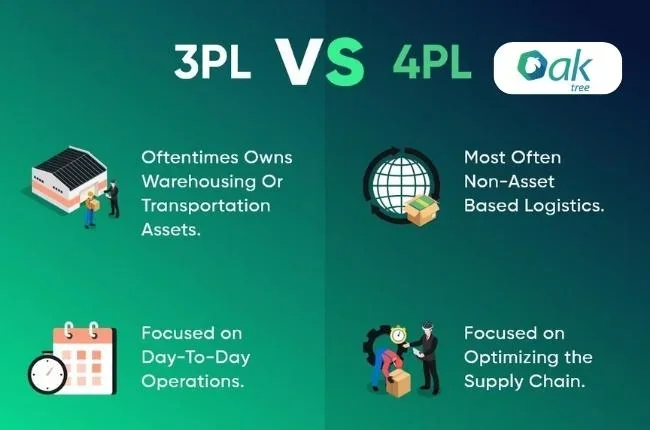
Logistics is one of the most important aspects of a company’s supply chain. To optimize logistics processes, companies can use 3PL (Third-Party Logistics) and 4PL (Fourth-Party Logistics), which offer effective and efficient solutions. In this article, we’ll take an in-depth look at the differences between 3PL and 4PL, as well as the benefits of each.
Understanding 3PL (Third-Party Logistics)
3PL or Third Party Logistics refers to a third party that manages logistics operations for a company. They provide a range of logistics services, such as warehousing, transportation, order fulfillment, and inventory management.
Functions and Services of 3PL
The main functions of 3PL include providing logistics infrastructure, order fulfillment, inventory management, shipping and transportation, and shipment monitoring and tracking. 3PL services include storage and warehousing, distribution, cargo consolidation, and logistics risk management.
Benefits of Using 3PL Services
Companies that use 3PL services can benefit in many ways. By relying on logistics experts, they can save on operating costs, increase efficiency, and focus on their core business activities. For example, companies that have optimized their supply chains with 3PL can reduce shipping costs and improve customer service levels.
Understanding 4PL (Fourth-Party Logistics)
4PL is a more advanced concept in logistics services. 4PL providers are responsible for coordinating and integrating the entire supply chain, including various logistics providers and business partners.
Functions and Responsibilities of 4PL
4PL providers act as the primary supply chain manager, coordinating various logistics services and integrating information from all parties involved. They are responsible for strategic planning, performance monitoring, risk management, and ongoing supply chain innovation and improvement.
Benefits of Using 4PL Services
By using 4PL services, companies can optimize efficiency, increase transparency, and gain greater flexibility across their supply chains. 4PL providers play an important role in building strategic relationships with logistics providers and business partners, offering comprehensive and innovative solutions.
Differences Between 3PL and 4PL
- Structure and Roles. The main difference between 3PL and 4PL lies in their organizational structure and roles. 3PL focuses more on carrying out logistics operations, while 4PL is responsible for managing the entire supply chain and business strategy.
- Level of Control and Involvement. Another difference is the level of control and involvement offered by 3PL and 4PL. 4PL provides greater control over supply chain management, with more strategic involvement in decision-making and long-term planning.
- Service Scale. 3PL tends to provide logistics services on a more limited scale, while 4PL can integrate various logistics services and partners to deliver more comprehensive and efficient solutions.
When Should You Use 3PL or 4PL?
- Business Considerations
When choosing between 3PL and 4PL, companies should consider a range of factors, including their business needs. 3PL is a better fit when a company needs a specific logistics solution focused on operations. 4PL, on the other hand, is a better choice when a company needs more complex supply chain integration and coordination. - Operational Scale. A company’s operational scale also affects the decision to use 3PL or 4PL. Larger companies tend to choose 4PL because they need more complex logistics solutions and extensive integration across their supply chains.
- Supply Chain Needs
Specific supply chain requirements are another important consideration when choosing between 3PL and 4PL. If a company faces complex challenges, such as a global supply chain or specialized product handling requirements, 4PL can provide a more effective solution by coordinating the entire logistics network.
Conclusion
To optimize logistics processes and improve supply chain efficiency, companies need to understand the differences and benefits of 3PL and 4PL services. When choosing between the two, companies should consider their business needs, operational scale, and specific supply chain requirements. By choosing the right logistics solution, companies can improve efficiency, flexibility, and business performance.