


For companies that import goods, customs clearance is one of the steps that must be carefully managed. Goods cannot simply be released from the port upon arrival.
There are documents that must be submitted, customs duties and taxes that need to be paid, and other requirements that must be met.
For companies that aren’t yet accustomed to handling imports independently, this process can be quite complicated. Errors in goods data, documentation, classification, or customs value can prolong the process of releasing the goods.
So, what exactly is customs clearance, and how does the process work?
What Is Customs Clearance?
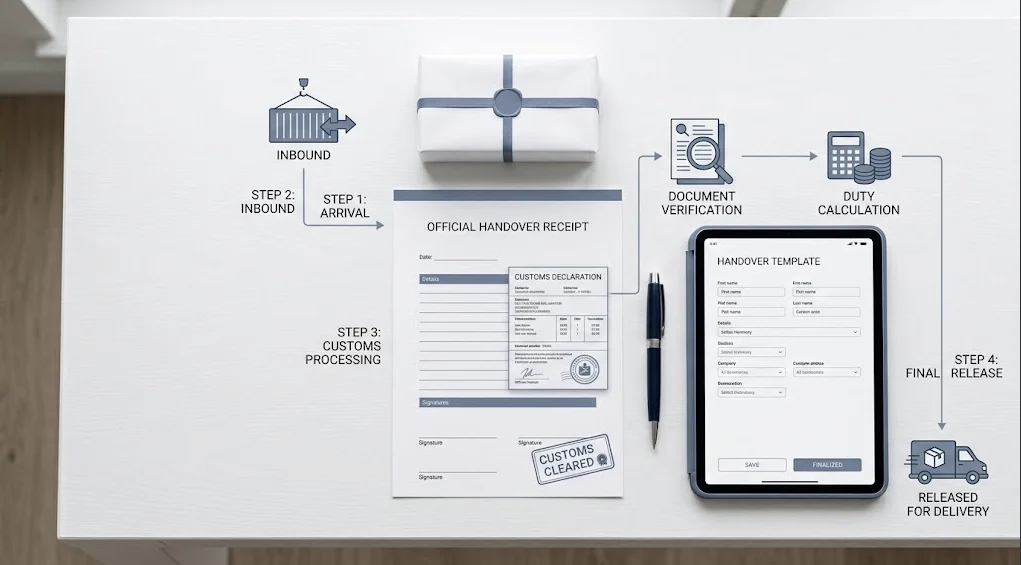
Customs clearance is the process of fulfilling customs obligations so that imported or exported goods can be processed in accordance with regulations and released or shipped in accordance with applicable procedures.
In the context of imports for domestic use, the process involves, among other things, the Import Goods Declaration (PIB), supplementary customs documents, payment of import duties and taxes (PDRI), compliance with prohibitions and restrictions, and customs inspections if required.
In business practice, the term “customs clearance” is often used to refer to the entire process of handling goods through customs. This process can be carried out by the importer themselves or with the assistance of a party that has the authority and expertise in customs procedures.
Documents Required for Customs Clearance
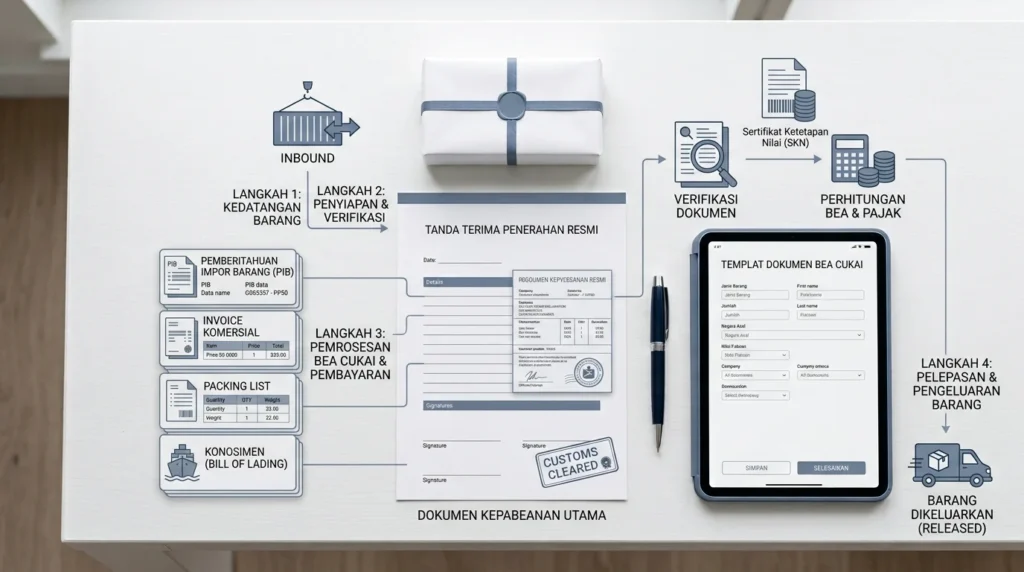
The required documents may vary depending on the type of goods, the import scheme, and applicable regulations. For imports intended for use, the PIB is prepared based on supporting customs documents.
Some commonly used documents include:
- Commercial invoice
- Packing list
- Bill of Lading (B/L) for ocean shipments
- Air Waybill (AWB) for air shipments
- Permit documents for specific goods
- Other documents required based on the characteristics of the goods
The importer or the party handling customs clearance must ensure that the information in these documents matches the actual goods.
How Does the Customs Clearance Process Work?
The process can be described as follows:
Goods arrive → documents are prepared → PIB is submitted → duties are paid → inspection if required → release approval → goods are released.
Here is an explanation of each stage.
1. Goods Arrive and Are Presented to Customs
After the goods arrive in Indonesia, the process of releasing them from the customs zone is carried out through the applicable customs procedures.
For imports by sea, goods are generally held in a temporary storage area or facility while awaiting the settlement of customs duties.
2. Preparing and Submitting the PIB
The importer submits the Goods Import Declaration (PIB) based on supporting customs documents. The data included covers information on the importer, transportation, goods, value, country of origin, and goods classification.
At this stage, data accuracy is crucial because the PIB serves as the basis for the import obligation settlement process.
3. Calculating and Paying Import Duties and Taxes
The importer is responsible for calculating and paying import duties, excise taxes (if applicable), and PDRI in accordance with applicable regulations.
These calculations are based on the classification of goods, customs value, tariffs, and the types of levies imposed.
4. Customs Inspection
Not all imported goods automatically undergo physical inspection.
Customs uses a risk-based surveillance system. The import process for goods intended for use includes the Green Channel and the Red Channel.
The Red Lane involves document review and physical inspection before goods receive release approval, whereas the Green Lane does not require a physical inspection before release approval is issued.
If a physical inspection is conducted, officers can verify that the condition and type of goods match the information declared in the documents.
5. Goods Receive Release Approval
Once customs requirements are met—including the completion of payment or the provision of a bond if required, as well as compliance with prohibitions and restrictions—Customs may issue a Goods Release Approval Letter (SPPB).
Once this approval is issued, the goods may be released from the customs zone in accordance with applicable procedures.
Why Does Customs Clearance Often Feel Complicated?
The complexity lies not only in the sheer volume of documents. Data from invoices, packing lists, transport documents, and the PIB must all match.
In addition, companies must pay attention to the classification of goods, customs value, tariffs, taxes, as well as prohibitions and restrictions. When one part needs to be corrected, the goods release process can be affected.
Therefore, companies that handle many shipments usually require a more structured workflow and data management system.
Customs Clearance with the Help of a Freight Forwarder
Companies do not always have to handle the entire process on their own. Freight forwarders can help coordinate shipments and administrative requirements based on the services they provide.
For companies with high import volumes, using a digital system can also help reduce repetitive data entry and make it easier to monitor each shipment.
Manage the Freight Forwarding Process with Oaktree
Oaktree provides an application to help freight forwarding companies manage shipment activities, documents, customers, costs, and operational processes within a single system.
With more centralized data, teams can reduce repetitive administrative work and more easily monitor the progress of each shipment.
Want to learn how Oaktree can be used for your company’s freight forwarding operations?
[oak_banner style="2" url="https://www.oaktree.id/ads/?utm_source=blog&utm_medium=internal&utm" title="An Easy Way to Manage Customs Clearance Documents with the Custom Clearance App" cta="Try for Free"]
What About Temporary Imports?
In addition to imports for domestic use, there is a temporary import scheme for goods that will be used in Indonesia for a specific period and then re-exported.
This facility has its own requirements. One of them is that the goods must be identifiable as the same items when re-exported, and their intended use must be clear. Under certain conditions, temporary imports may qualify for import duty exemptions or reductions.
Therefore, temporary imports cannot be equated with the standard import process. Companies need to ensure that the type of goods and their intended use comply with applicable regulations.
For companies handling a large volume of shipments, data accuracy and document management are critical. An integrated system can help streamline these processes and make them easier to monitor.